

Everyday English

Solid English for further advancement.

English has become indispensable in the aeronautical, professional, and international spheres. The General English training offered by Hexagone Aviation School is designed for students who wish to progress at their own pace with a dedicated instructor, attentive monitoring, and a teaching methodology fully adapted to their level, objectives, and needs.

Whether you are a beginner, intermediate, or advanced learner, this program enables you to enhance your listening comprehension, expression, vocabulary, and fluency in the language, while simultaneously boosting your daily confidence.

Benefits

Hexagone Aviation School

  • Specialized and Experienced Instructors

    Specialized and Experienced Instructors

    All our instructors are native English speakers or perfectly bilingual.

  • 100% Personalized Courses

    100% Personalized Courses

    Each session is meticulously adapted to your proficiency level, learning pace, and specific objectives, ensuring progress precisely where it is most required.

  • Professional Pedagogical Methods

    Professional Pedagogical Methods

    Our courses are founded upon modern, interactive, and efficient pedagogical approaches, including scenario-based learning, guided dialogues, practical exercises, and comprehensive multimedia resources.

  • Professional School Environment

    Professional School Environment

    You benefit from a motivating, structured, and rigorous learning environment that fosters continuous acquisition of knowledge and consistent professional advancement.

  • Individual Monitoring and Measurable Progress

    Individual Monitoring and Measurable Progress

    A dedicated instructor meticulously analyzes your progress, refines your program, and facilitates your sustained professional development.

  • Total flexibility: on-site or remote via videoconference

    Total flexibility: on-site or remote via videoconference

    You select the format that best suits your needs — either on-site in Beauvais or online — with scheduling options designed to accommodate your operational constraints.

The General English (“Every Day English”) training aims to strengthen your command of English through progressive, personalized, and practice-oriented learning.
It enables you to acquire essential linguistic skills to communicate with clarity, confidence, and fluency in various everyday and professional situations.

Specifically, upon completion of the training, you will be able to:

  • Understand and use clear and natural English, adapted to your level and context,
  • Develop more fluid oral expression, with more precise pronunciation and accurate phrasing,
  • Enrich your vocabulary in common themes (daily life, social interactions, work, travel…),
  • Strengthen your grammatical foundations to construct correct, coherent, and varied sentences,
  • Understand simple to intermediate documents: audio, video, conversations, written messages,
  • Interact with greater confidence in real-life situations: making contact, spontaneous discussion, simple presentations,
  • Structure and draft texts in English, such as messages, emails, or descriptions,
  • Identify your areas for improvement, through individual monitoring and personalized feedback from your instructor.

Our objective is clear: to enable you to acquire a solid, natural, and lasting command of English, which will serve you both in your daily life and in your future training or professional endeavors.

English is now an indispensable skill in most professional environments, particularly within international, technical, and aeronautical sectors.
This individual course training aims to enable you to utilize English as a genuine professional tool, capable of supporting your career advancement and expanding your opportunities.

Specifically, this training will enable you to:

  • Communicate with greater fluency in a professional setting, during simple meetings, informal exchanges, calls, or daily interactions,
  • Understand and utilize vocabulary appropriate for work, organizational structures, assignments, and routine communications,
  • Present ideas, instructions, or information clearly, structured, and comprehensibly,
  • Interact with international stakeholders (colleagues, clients, students, partners, etc.),
  • Develop the necessary confidence to operate effectively in an environment where English is regularly used,
  • Establish essential linguistic foundations prior to engaging in more technical training programs (TOEIC, Aviation English, FCL.055),
  • Enhance your employability by demonstrating your proficiency in communicating in the world's most widely used language.

In summary, this training aims to transform your English proficiency into a tangible professional asset, enabling you to advance your career, adapt swiftly, and seize new opportunities within an increasingly globalized context.

The General English (« Every Day English ») training program is designed for anyone seeking to improve their English proficiency through personalized support. It is suitable for both aviation students and individuals aiming to enhance their language skills for personal or professional development.

This training is particularly suited for:

  • pilot trainees wishing to enhance their English proficiency before undertaking more technical modules (Aviation English, TOEIC, FCL.055),
  • students or prospective students operating in an international environment,
  • professionals seeking a higher level of English proficiency for their professional interactions, communications, or assignments,
  • individuals wishing to revisit the fundamentals or consolidate their English skills after a period of non-practice,
  • candidates for competitive examinations or programs requiring a minimum level of English proficiency,
  • anyone seeking rapid progress through tailored individual lessons,
  • learners requiring flexible schedules or a format adaptable to their lifestyle (in-person or virtual).

In short, this training is for anyone who wishes to develop clear, fluent, and confident English, with individualized support.

The General English training program is accessible to all and requires no specific linguistic prerequisites. It is suitable for complete beginners as well as learners who already possess foundational or intermediate proficiency.

To ensure tailored progress for each student, Hexagone provides for:

  • an initial placement test (oral and/or written) to assess your current knowledge,
  • an educational interview to define your objectives, needs, and learning pace,
  • a personalized learning path proposal, structured according to your proficiency level and expectations.

No prior documents, certifications, or diplomas are required. Only your motivation and desire to progress are essential.

To ensure effective learning and a curriculum truly adapted to your proficiency level, Hexagone implements a systematic entry-level assessment for each new student.

This placement assessment includes:

  • A proficiency test (comprehension and expression) to identify your current knowledge,
  • An individual consultation with an instructor to understand your needs, objectives, and past English language experience,
  • A personalized analysis of your strengths and areas for improvement,
  • The definition of a tailored training plan, adapted to your pace, expectations, and personal or professional project.

This initial placement ensures that each student begins training at the appropriate level, with a coherent and effective program, and benefits from truly individualized instruction from the very first session.

Multiple training sessions available throughout the year

Practical Information

Training Duration

Flexible – based on the number of hours chosen (individually or in packages)

Maximum Enrollment

1 student per session (individual lesson)

Head of Administration and Finance

Bernard Binet

Language

English

Financing

Self-funded. Other possibilities available upon specific arrangement.

Head of Training

Brigitta NAGY

Training Location

On-site training at our Beauvais school or via videoconference.

Training Fee

€40/hour including tax
Or as a package starting at €1,400 including tax for 35 hours of lessons

Instructional team

Training Structure

Personalized Placement Interview
  • 01

Before commencing the training, you will undergo an individual interview to assess your current English proficiency, define your objectives, and identify your specific needs.
This discussion enables us to construct a curriculum perfectly tailored to your profile.

Defining Your Tailored Curriculum
  • 02

Based on your current level and objectives, we develop a personalized learning plan: covering vocabulary, listening comprehension, speaking, grammar, and practical scenarios.
You will receive a clear roadmap, adapted to your pace and expectations.

Individual Sessions with Your Instructor
  • 03

You will attend individual lessons of one hour or more with a dedicated instructor.
Sessions focus on conversation, pronunciation, comprehension, practical exercises, and vocabulary enrichment.
Each session is adjusted according to your progress.

Personal Study and Supplementary Resources
  • 04

Between sessions, you will benefit from resources provided by your instructor: including vocabulary sheets, audio materials, exercises, and personalized advice.
This personal study reinforces your learning and accelerates your progress.

Continuous Monitoring and Adjustments
  • 05

Throughout the training, your instructor conducts regular assessments to measure your progress, identify areas for improvement, and adjust the program as needed.
You will advance with constant and individualized support.

Final Assessment and Recommendations
  • 06

At the end of the training, an interview allows for a comprehensive review of your achievements, progress, and final proficiency level.
We then propose a continuity plan:

  • Aeronautical English
  • TOEIC Preparation
  • FCL.055 Preparation
  • Or continuation with individual or group courses

Training Program

The program is entirely personalized, yet it is built upon a coherent pedagogical structure to ensure robust progression. Below is the typical architecture followed by students, adjusted according to their level, needs, and objectives.

Discovery Level – A0 to A1

This initial phase is designed for students who are new to English or who wish to consolidate essential foundations for communicating in simple everyday situations. The objective is to acquire indispensable fundamentals: basic grammatical structures, the most common vocabulary, comprehension of simple sentences, and immediately useful expressions.


Skills developed by the end of the phase

By the end of the Beginner phase, the learner is capable of:

  • Introduce themselves, talk about themselves, and interact in very common situations (café, airport, hotel, meeting).
  • Ask and answer simple questions.
  • Describe objects, places, and people.
  • Express tastes, preferences, and habits.
  • Understand and produce short sentences, in the simple present tense and using the verb be.
  • Understand announcements, prices, numbers, schedules, and simple instructions.


Educational Content – Beginner

  1. Essential Communication Fundamentals
  • Greetings, polite expressions, simple requests.
  • Order a coffee or a meal, ask for a price, find one's way.
  • Initial exposure to listening comprehension (everyday situations).
  1. Fundamental Grammar
  • Verb be in singular and plural: I am / you are / he is / they are.
  • Articles a / an, singular and plural nouns.
  • Possessive adjectives.
  • Simple present tense (I live, I work, I like).
  • Common Questions: What? Where? Who?
  • Can / can’t to express ability and permission.
  • Initial frequency markers (always, sometimes, never).
  1. Key Vocabulary
  • Numbers 0–100, dates, months, days.
  • Countries, nationalities, family, professions.
  • Colors, everyday objects, food, clothing, common places.
  • Daily activities and common verbs.
  • Practical vocabulary: hotel, restaurant, airport, shopping.
  1. Oral Comprehension & Expression
  • Short dialogues and simple situational exercises.
  • Discussing preferences, daily routine, and possessions.
  • Responding in very simple exchanges: purchases, reservations, requesting assistance.
  • Initial thematic dialogues: travel, leisure, family.
  1. Basic Pronunciation and Phonetics
  • Basic sounds: /h/, /ʃ/, /ʒ/, /θ/, /ð/.
  • Rhythm & sentence stress: emphasis on keywords.
  • Alphabet and spelling (useful for radio communication, reservations, proper nouns).
  • Differentiating similar sounds (ship/sheep, live/leave, can/can’t).
  1. Practical Situations (“Practical English”)
  • Booking a hotel, buying a ticket, ordering in a cafe.
  • Telling time, giving simple directions.
  • Managing short interactions in real-life contexts.


Outcome of the Beginner Phase

Upon completion of this phase, the student will have mastered the essential fundamentals to progress to the Elementary level.
They will communicate more confidently in daily situations, understand simple structures, and possess a solid foundation for engaging in richer exchanges.


Elementary Level – A1 to A2

This second phase is designed for students who have mastered the basics of English (simple present, the verb to be, basic adjectives, essential everyday vocabulary) and who wish to develop their fluency, enrich their grammar, and begin to express themselves in more varied and independent situations.
The objective of this stage is to broaden grammatical structures, enhance oral comprehension, utilize a richer vocabulary, and be able to hold short, coherent conversations in various daily contexts.


Skills developed by the end of the phase

By the end of the Elementary phase, the learner will be able to:

  • Discuss their daily routine, family, work, hobbies, and future plans.
  • Understand and utilize the simple present, the present continuous, and the simple past (regular and irregular verbs).
  • Formulate correct questions and engage in short conversations on concrete topics.
  • Describe a place, a journey, accommodation, a meal, an event, or a past experience.
  • Express preferences, give opinions, and narrate a simple story.
  • Understand instructions, short announcements, everyday dialogues, and follow a simple conversation.
  • Read and comprehend short texts: emails, signs, messages, descriptions.


Educational Content – Elementary

  1. Communication & Everyday Situations
  • Discuss one's routine, activities, and schedule.
  • Describe people: appearance, character, family relationships.
  • Order in a restaurant, make purchases, inquire about prices, and compare.
  • Describe accommodation, a neighborhood, or a tourist location.
  • Discuss travel, journeys, and give and understand directions.
  • Narrate simple past events (holidays, weekends, experiences).
  • Express opinions, agreement/disagreement, and preferences.


  1. Grammar – Consolidation and New Tools
  • Simple present / present continuous (be + -ing): difference, uses, questions.
  • Simple past: regular and irregular verbs (to be, to go, to have, to see, to get, etc.).
  • There is / there are, some / any, quantifiers (much/many/a lot of).
  • Adverbs of frequency & time expressions.
  • Comparatives & superlatives (bigger, more expensive, the most dangerous).
  • Simple future with 'be going to': intentions, plans, predictions.
  • Definite and indefinite articles: a / an / the.
  • Can / can’t for permission and abilities.
  • Interrogative structures: Where? When? How much? Why? etc.
  • Imperatives for giving instructions.


  1. Thematic Vocabulary
  • Family, work, leisure activities, daily routines.
  • Food & drinks, restaurant, cooking.
  • Accommodation, cities, public places, transportation.
  • Clothing, weather, holidays, everyday objects.
  • Dates, times, numbers, time expressions.
  • Frequent verbs, daily actions, feelings.
  • Travel vocabulary: airport, hotel rooms, directions.


  1. Oral Comprehension & Expression
  • Real-life dialogues with guided comprehension.
  • Simple conversations: recounting a weekend, expressing an opinion, describing an image.
  • Role-plays: at the hotel, at the shop, at the restaurant, while traveling.
  • Understanding a past narrative, describing a personal experience.
  • More fluid exchanges through a more varied vocabulary and grammar.


  1. Pronunciation and Phonetics
  • Complex sounds: /ʃ/, /ʒ/, /ʧ/, /ʤ/, /θ/, /ð/, /ŋ/.
  • Sentence stress and intonation.
  • Sounds of the simple past: -ed /t/, /d/, /ɪd/.
  • Word linking and sentence rhythm.
  • Distinction of similar sounds: live/leave, ship/sheep, writer/waiter, etc.


  1. Practical Situations (“Practical English”)
  • Asking for directions, following instructions, understanding directions.
  • Book a room, purchase a ticket, rent a vehicle.
  • Describe a problematic situation (delay, error, incorrect order).
  • Make an in-store or online purchase, request a refund.
  • Introduce oneself in a simple professional setting.


Outcome of the Elementary phase

Upon completion of this phase, the student will:

  • Communicate with greater confidence in common situations.
  • Understand and produce longer, better-structured sentences.
  • Can recount past events, express future plans, and compare situations.
  • Possess a solid foundation to approach the Pre-Intermediate phase, where they will develop their fluency, precision, and ability to engage in sustained conversations.

Pre-Intermediate Level – A2 to B1

The Pre-Intermediate phase is designed for students who already possess essential English fundamentals (simple present, verb be, short sentences) and wish to expand their communication capabilities.
The objective is to enable the learner to interact in a wider range of situations, utilize more varied tenses (present continuous, simple past), and significantly enrich their everyday vocabulary.


Skills developed by the end of the phase

By the end of the Pre-Intermediate phase, the learner will be able to:

Communication & Interaction

  • Discuss daily life, work, travel, and leisure activities.
  • Describe places, people, and past events.
  • Engage in more natural short conversations (opinions, plans, simple emotions).
  • Navigate practical situations: restaurant, shopping, hotel, directions.
  • Give and request more detailed information.

Grammar & Structures

Correctly use:

  • present continuous (ongoing actions, future arrangements)
  • simple past (regular and irregular)
  • be going to (plans / predictions)
  • present perfect + for / since (introduction to compound tenses)
  • Simple conditional statements (first conditional)
  • can / have to / must / mustn’t
  • Object pronouns, possessives, quantifiers (some / any / much / many)
  • Comparatives and superlatives

Oral Comprehension & Expression

  • Comprehend faster-paced daily conversations.
  • Express oneself with greater fluency about oneself, one's routine, and past experiences.
  • Follow a simple conversation and respond appropriately.
  • Recognize key sounds: /ə/, /ɪ/, /ʌ/, /ɔː/, as well as stress patterns.

Reading & Vocabulary

  • Understand short texts on various themes: travel, weather, family, work, simple news.
  • Extended vocabulary: appearance, personality, places, food, emotions, descriptions, travel, shopping, hobbies, urban life, animals, health.


Curriculum – Pre-intermediate

  1. Consolidation of fundamentals & initial advanced structures
  • Simple questions: Are you? Do you? Did you?
  • Introduction to the present continuous.
  • Describe appearance, personality, clothing.
  • Call a reception / ask a question in a public place.
  1. Mastery of the simple past
  • Simple past regular & irregular: went, got, saw, took…
  • Discuss a memory, a trip, a past weekend.
  • Temporal connectors: after, before, then, finally…
  • Prepositions of place and time: at, in, on…
  1. Introduction to future tenses & detailed descriptions
  • be going to for plans and predictions.
  • present continuous for future arrangements.
  • Describing a place, a space, an event.
  • Practicing simple paraphrases and reformulations.
  1. Present perfect & past / present contrast.
  • Present perfect with for / since.
  • Differences between present / past / personal experience.
  • Shopping, household chores, daily life.
  1. Comparatives, superlatives, and quantifiers.
  • bigger, more expensive, the most beautiful…
  • Quantity: too much, too many, enough…
  • Health, food, healthy lifestyle.
  1. Modal verbs and simple hypotheses.
  • will / won’t (predictions, spontaneous decisions)
  • should / might
  • First conditional : If it rains, I’ll stay home
  • Confusing verbs, basic rules: say / tell, go / come…
  1. Infinitives & gerunds.
  • want to do, need to go, enjoy doing, stop doing…
  • Expressing preferences, wants, and plans.
  1. Pronouns, adverbs & advanced everyday structures.
  • Object pronouns, possessives.
  • Adverbs of manner.
  • Movements and directions: go up, turn left…
  • Nationalities, countries, cultures.
  1. Telling a story or an event.
  • Simple Past + logical connectors: first, then, suddenly…
  • Vocabulary for biographies, anecdotes.
  • Animals, insects, nature, fears.
  1. Buildings, sports, inventions
  • Basic phrasal verbs.
  • Describing an invention, a sport, a public place.
  • Basic passive voice: It was invented in…
  1. Past habits & comparison
  • used to / didn’t use to
  • Similarities and differences: both, neither…
  • Internet, technologies, habits.
  1. Review & consolidation
  • Past perfect (introduction).
  • Very simple structures in reported speech.
  • Complex questions: Wh- questions + auxiliaries
  • Final assessment of comprehension and expression.


Outcome of the pre-intermediate phase

  • Upon completion of this phase, the learner can:
  • participate in a simple conversation,
  • understand and use various verb tenses,
  • recount a past experience,
  • talk about their plans,
  • manage in most common travel situations,
  • understand simple announcements and follow everyday exchanges.

Intermediate level – B1 to B2

The Intermediate phase is designed for learners who already possess a solid grasp of communication fundamentals and are capable of interacting effectively in most everyday situations.
The objective of this phase is to deepen English proficiency by reinforcing complex grammatical structures, significantly expanding vocabulary, and developing more refined skills: precision in expression, nuance, argumentation, clarity in exchanges, and comprehension of more natural English.

This phase marks the transition towards more autonomous, fluent, and structured English.


Skills developed by the end of the phase

Upon completion of the Intermediate phase, the learner will be able to:

Oral Expression & Interaction

  • Express themselves with greater fluency on a variety of topics: work, society, daily life, travel, and general knowledge.
  • Give their opinion, express agreement/disagreement, add nuance to their statements, and justify their ideas.
  • Manage longer conversations, react spontaneously, and produce more detailed discourse.

Oral Comprehension

  • Understand the gist of natural conversations (films, podcasts, discussions), even when opinions diverge or the speaking pace is faster.
  • Follow more complex explanations: instructions, descriptions, narratives, and testimonials.

Grammar & Linguistic Precision

  • Correctly use past tenses: past simple, past continuous, present perfect, past perfect.
  • Master complex future tenses: will, going to, future forms with time clauses.
  • Employ modals of deduction, probability, and obligation: must, might, can’t, should, have to.
  • Construct complex sentences with connectors: although, however, unless, while, when, until…
  • Use conditional forms (1st & 2nd conditional), comparatives, superlatives, and advanced structures.

Advanced Vocabulary

  • Speak precisely on various topics: family, work, cinema, health, environment, technology, money, lifestyles, and transport.
  • Use frequent collocations (verb + preposition, adjective + preposition).
  • Employ more nuanced vocabulary: emotions, opinions, and simple idiomatic expressions.

Pronunciation & Phonetics

  • Improve clarity by focusing on:
         – sentence stress
         – linking
         – long/short vowels
         – diphthongs
         – complex consonants (th, j, ch, sh…)
  • Understand and reproduce more natural rhythmic patterns.


Curriculum – Intermediate

  1. Advanced Mastery of Tenses & Actions
  • Present Simple / Continuous: precision and nuance.
  • Present perfect simple vs continuous: discussing experiences, changes, and ongoing situations.
  • Past simple vs past continuous: narrating an event.
  • Future forms: be going to, will, might, won't, future arrangements.
  1. In-depth thematic vocabulary
  • Family, relationships, personalities.
  • Work, personal goals, schedules.
  • Health, stress, emotions, and well-being.
  • Cooking, leisure activities, cinema, sports, media.
  • Money, expenditures, purchasing behaviors.
  • Transportation, travel, environment, homes, and lifestyles.
  1. Intermediate written & oral comprehension
  • Longer articles, narratives, profiles, interviews.
  • Educational videos and faster-paced dialogues.
  • Understanding nuances, opinions, and contrasts.
  1. Structured written expression
  • Drafting clear text: emails, messages, short descriptions.
  • Past narratives, comments, opinions, simple mini-essays.
  • Logical connectors: however, therefore, in my opinion, although…
  1. In-depth intermediate grammar
  • Modals: must, might, can't, should, have to, would.
  • Conditionals: if + present / will; if + past / would.
  • Advanced comparative structures.
  • Articles a / an / the: precise usage.
  • Passive voice (simple introduction).
  • Gerund & infinitive: verb + -ing / verb + to.
  • Reported speech (foundational).
  1. Pronunciation & Phonetics
  • Emphasis on key concepts.
  • Reduction of weak forms.
  • Frequent diphthongs.
  • Complex sounds: /θ/, /ð/, /ʃ/, /ʒ/, /tʃ/, /dʒ/.
  1. Practical Situations (“Practical English”)
  • Interactions in transportation, hotels, restaurants, and shops.
  • Giving and asking for advice, making suggestions.
  • Expressing uncertainty, probability, permission, and obligation.
  • Navigating unforeseen situations: delays, issues, reservations, requesting assistance.


Outcome of the Intermediate phase

Upon completion of this phase, the student communicates confidently in various conversations.
Their English becomes:

  • more natural,
  • more autonomous,
  • more precise,
  • capable of addressing less familiar topics,
  • capable of expressing complex ideas with nuance.

They are thus prepared to advance to the Advanced level, where the objective will be to achieve near-fluent proficiency, an extensive vocabulary, and the ability to address complex subjects — particularly those related to aeronautics, should they pursue Aviation English.

Advanced Level – B2 to C1

The Advanced phase is designed for learners who are already highly proficient in English and wish to achieve precise, nuanced, and professional mastery of the language. This level allows for the refinement of linguistic skills to comprehend and produce rich, complex, and natural English, both in daily life and within an aeronautical or technical environment.
The objective is to enable students to manipulate advanced structures, express themselves with subtlety, and confidently interact on specialized, abstract, or demanding subjects.


Skills developed by the end of the phase

Upon completion of the Advanced phase, the learner will be capable of:

  • Comprehend complex, rapid, or accented discourse, including technical or specialized subjects.
  • Utilize a rich vocabulary, idiomatic expressions, and natural phrasing to articulate nuanced opinions and well-constructed arguments.
  • Employ advanced grammatical structures: inversion, complex reported speech, advanced passive forms, modals of deduction, and sophisticated subordination.
  • Interpret implicit meanings, undertones, tone, attitudes, and intentions.
  • Engage in fluent and structured professional conversations, particularly within an aeronautical, operational, technical, or academic context.
  • Generate oral or written presentations, explanations, and reports with precision, clarity, and coherence.
  • Comprehend nearly all written texts, including technical documents, professional articles, specialized publications, or literary narratives.


Curriculum Content – Advanced

  1. Advanced Grammar Consolidation
  • Advanced use of have (lexical and grammatical), emphatic structures.
  • Inversion for emphasis.
  • Complex conditionals (mixed, unreal hypotheses, re-evaluation of the past).
  • Advanced reported speech (reporting, nuances, interpretation).
  • Cleft sentences, ellipses, condensed structures.
  • Complex relative clauses (defining, non-defining, embedded).
  • Advanced subordination: concession, contrast, gradation, consequence.
  • Modals of certainty, speculation, deduction, and analysis.
  1. Specialized Vocabulary and Advanced Register
  • Professional vocabulary: aviation, operations, technology, human performance.
  • Idiomatic expressions, advanced phrasal verbs, advanced collocations.
  • Formal, neutral, and informal registers: adapting language to context.
  • Complex Lexicon:
  • psychology, perception, attitudes, emotions;
  • art, history, literature;
  • economics, society, environment;
  • science, medicine, technology.
  • Lexical construction: affixes, derivations, word families.
  1. Advanced Oral Comprehension & Expression
  • Extended and argumentative discussions on abstract or technical subjects.
  • Analysis and commentary of authentic audio materials: reports, podcasts, conferences, operational communications.
  • Development of interpretation skills: tone, intent, subtext.
  • Professional presentations: briefings, syntheses, analyses.
  • Advanced narration (complex past events, hypotheses, detailed opinions).
  • Structured debates, nuanced expression of agreement/disagreement, and stating a position.
  1. Expert reading and written comprehension.
  • Long, abstract, or technical texts: specialized articles, professional documents, studies.
  • Identification of a text's logical structure: idea progression, argumentation, implication.
  • Recognition of the author's style, tone, and intent.
  • Management of multiple, cross-referenced, or contradictory information.
  1. Advanced written production.
  • Drafting of detailed and structured texts:
  • reports, analytical summaries;
  • elaborate professional emails;
  • narrations, complex descriptions;
  • long and nuanced arguments.
  • Clear, precise, coherent style; advanced use of logical connectors.
  • Refined grammatical correction and mastery of lexical nuances.
  1. Advanced pronunciation & phonology.
  • Primary and secondary stress.
  • Rhythm of English: fluidity, expressive intonation, naturalness of speech.
  • Focus on consonant clusters, homophones, and complex diphthongs.
  • Harmonization of delivery, clarity, and naturalness.
  • Refinement in professional communication (telephone, meetings, presentations).
  1. Practical situations (advanced level).
  • In-depth conversations on work, family, history, culture, society.
  • Discussion of complex cases, critical thinking, reasoned analysis.
  • Professional scenarios: explaining a problem, justifying choices, advising, arguing.
  • management of technical information;
  • comprehension of specialized discourse;
  • precise and professional formulation, outside of operational phraseology.


Outcome of the Advanced phase

Upon completion of this phase, the student achieves a solid, fluid, and natural command of English, adapted to:

  • professional life,
  • technical or specialized contexts,
  • demanding exchanges,
  • international environments.

The student is capable of interacting with ease with native English speakers, understanding complex content, and expressing precise, structured, and nuanced ideas.

Key Competencies Developed During Training

Methods Utilized

Educational Tools and Resources

Benefits

Flexible learning, focused on your objectives

  • Personalized guidance

    Personalized guidance

    Progress under the direct supervision of a dedicated instructor, who supports you in each session, answers your questions, and adapts the content to your actual needs.

  • Flexible scheduling and tailored pace

    Flexible scheduling and tailored pace

    Choose your schedule, course frequency, and pace of progression. The training adapts to your timetable, whether you prefer a steady or intensive advancement.

  • Modern methodologies

    Modern methodologies

    Benefit from a pedagogy focused on conversation, situational exercises, oral comprehension, and natural expression — a dynamic, practical, and effective learning approach.

  • Conducive learning environment

    Conducive learning environment

    Study within a professional school environment, conducive to learning and tranquility, or via video conference for greater flexibility, according to your preferences.

Assessment & Certification

Assessment Methods and Procedures

Assessment Methods and Procedures

The assessment of acquired knowledge is conducted continuously throughout the training, directly during individual sessions.
It is based on:

  • oral exercises evaluating fluency, pronunciation, and comprehension,
  • short written activities (simple messages, sentences, mini-texts),
  • guided situational exercises,
  • personalized feedback from the instructor during each session.

A final assessment identifies the progress made, skills acquired, and areas for development in your continued linguistic journey.
Means of Assessing Program Outcomes

Means of Assessing Program Outcomes

Each student benefits from individualized pedagogical support, comprising:

  • a session-by-session progress evaluation,
  • indicators such as fluency, listening comprehension, lexical richness, and grammatical accuracy,
  • personalized feedback, written or oral, to guide the learning process,
  • regular content adjustments based on the student's development.

Intermediate assessments are conducted to ensure consistent and measurable progress.

Examination Procedures by the Certifying Body

Examination Procedures by the Certifying Body

The General English training does not prepare for a mandatory or regulatory examination.
However, it provides an excellent foundation for preparing for:

  • the TOEIC,
  • aviation English,
  • the FCL.055,
  • or any international language certification.

Should the student wish to pursue a specific examination, Hexagone Aviation School assists them with:

  • guidance towards suitable training,
  • the selection of the complementary module (TOEIC, FCL055, etc.),
  • the registration procedures for official tests.
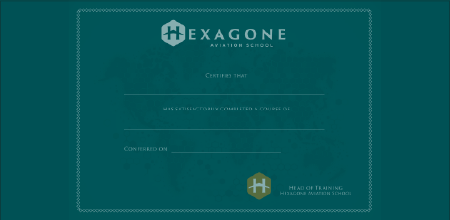
Training Certification and Course Completion Certificate

Training Certification and Course Completion Certificate

Upon completion of the training, a certificate of attendance is issued to the student by Hexagone Aviation School. This document confirms that the training has been successfully completed and specifies the total hours undertaken. It serves as official proof of participation and can be used as supporting documentation for further studies, administrative records, or enrollment in supplementary language training.


Training Quality and Compliance

The General English training offered by Hexagone Aviation School is based on rigorous pedagogical standards and a structured approach, tailored to the needs of learners in academic or professional contexts. It is delivered by qualified instructors, selected for their linguistic proficiency and experience in personalized guidance. The instruction employs a modern methodology, focused on individual progress, clear objectives, and high-quality pedagogical monitoring.

Career Prospects

Strengthening English proficiency is now an essential asset in many professional environments. This training enables learners to enhance their oral fluency, comprehension, ability to interact in an international context, and confidence in daily language use. It also provides an excellent foundation for achieving more advanced levels or certifications such as TOEIC, Aviation English, or FCL.055 preparation, thereby facilitating students' academic or professional advancement.

Further Training Progression

Upon completion of the training, students can naturally continue their linguistic progression through the various modules offered by Hexagone Aviation School. Depending on their objectives, they can opt for Aviation English, TOEIC preparation, FCL.055 preparation, or continue their learning through individual or group courses. This continuity allows for the consolidation of acquired knowledge, the deepening of skills, and the guidance of each learner towards an English proficiency level consistent with their personal, academic, or professional ambitions.

Success Rate 100 %
Progression to Further Study or Employment Rate 87 %
Professional Integration Rate 82 %
Certification Attainment Rate 95 %
Satisfaction Rate 100 %

Registration Procedures

1.

Online Application

2.

Prerequisite Validation

3.

Takeoff!

Contractual Information and Guarantees

You Have the Right to Change Your Mind

A statutory 14-day cooling-off period applies following the signing of the contract or training agreement, in accordance with Article L221-18 of the French Consumer Code.

In Case of Inability to Undertake Training

Should the training program be unable to be commenced or completed due to circumstances beyond your control (e.g., force majeure or incapacity), options for postponement, partial refund, or adjustment will be offered, in accordance with our pedagogical and administrative terms.

A Solution for Training Interruption

Any voluntary or involuntary interruption will result in a personalized review of your situation. Depending on the timing of the cessation, a partial refund, credit, or deferred resumption solution may be considered, in adherence to mutual commitments.

We Handle Every Dispute with Equity

In the event of a dispute, an amicable mediation process is preferred. If necessary, an appeal may be lodged with the consumer mediator or the competent courts. Our priority: dialogue, transparency, and the pursuit of solutions.

A Clear Reciprocal Commitment

Enrollment in the training program entails active commitment from the student: attendance, participation, and adherence to the pedagogical framework. For our part, we commit to providing the human, technical, and organizational resources necessary for the complete execution of the training.

A Secure Contractual Framework for Each Student

Each student, depending on their profile, signs either a training agreement or a professional training contract. This document specifies the pedagogical terms, the rights and obligations of each party, the financial conditions, and the execution modalities. It is supplemented by our General Terms and Conditions of Sale, available upon request.

Promoting mobility

Promoting gender diversity in professions

Anti-discrimination Policy

Promoting gender equality

Accessibility for Persons with Disabilities