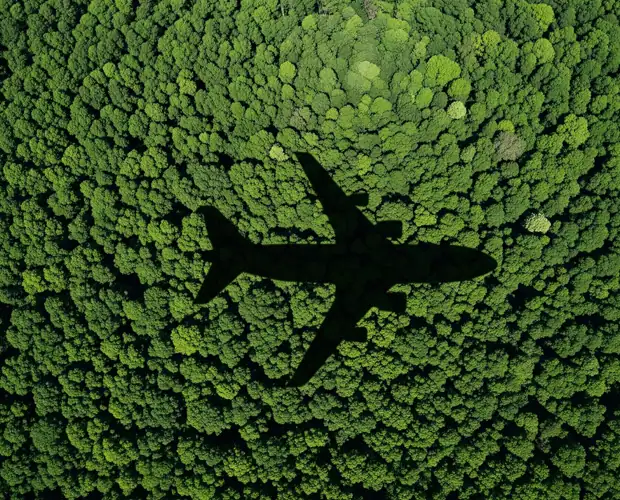

Accelerating the Energy Transition and Preparing Aviation for Tomorrow
Hexagone Aviation School is actively committed to the evolution towards more sustainable aviation. By exploring the use of alternative fuels and integrating the challenges of energy transition into its programs, the school raises students' awareness of the environmental issues facing the aviation sector. The objective is to train pilots capable of combining operational performance with ecological responsibility, at the forefront of innovations that will shape the future of air transport.
Aviation Facing the
Energy Challenge
Aviation holds an essential position in our modern society, whether for transport, commerce, or training. However, this sector also faces a major challenge: reducing its environmental impact and transitioning towards sustainable energy. At Hexagone Aviation School, we are fully aware of this responsibility. This is why we have integrated the issue of sustainable energies and fuels into the core of our development strategy and training programs. Our objective is clear: to prepare our student pilots to operate within an aviation sector undergoing significant transformation, where energy efficiency and sustainability are becoming indispensable standards.
Hexagone Aviation
School's Commitment
We recognize that the energy transition extends beyond a mere idea or concept; it must manifest through concrete actions. At our level, we are actively working to modernize our fleet, optimize aircraft utilization, and integrate innovations in alternative fuels. We closely monitor regulatory and technological developments concerning sustainable aviation fuels, hybrid and electric propulsion systems, and energy efficiency solutions. This commitment is not only a matter of environmental responsibility but also a means of providing our students with training that anticipates the future needs of aviation.
A Fleet Focused on Energy Efficiency
The energy transition begins with concrete choices regarding the fleet. At Hexagone Aviation School, we have opted for modern aircraft, designed to reduce fuel consumption compared to previous generations. Recent aircraft have been selected for their efficiency and their ability to offer an excellent balance between educational performance and a low environmental footprint.
Our aircraft undergo regular maintenance and cleaning to maintain optimal performance and prevent unnecessary overconsumption. This meticulous monitoring allows us to ensure safe, efficient, and environmentally responsible flights. We consider every liter of fuel saved a victory in the fight against greenhouse gas emissions.
Alternative Fuels: Towards a New Era
One of the primary avenues for reducing aviation's environmental footprint is the adoption of alternative fuels, often grouped under the term SAF (Sustainable Aviation Fuels). These sustainable fuels, produced from biomass, waste, or innovative synthesis processes, significantly reduce CO2 emissions compared to traditional fossil fuels.
At Hexagone Aviation School, we are preparing to integrate these new solutions as soon as they become available at the Beauvais platform. This foresight is fundamental: our students must be trained today on the challenges and use of these fuels, as they will encounter them throughout their careers in airlines. By fostering a culture of sustainability, we actively contribute to disseminating best practices within the aviation industry.
The Rise of Electric and
Hybrid Propulsion
The energy transition in aviation extends beyond fuels. The emergence of electric and hybrid aircraft marks a significant step towards greener aviation. These aircraft, being silent and direct emission-free, represent a particularly suitable solution for short-range flights, circuit training, and initial student pilot instruction.
Hexagone Aviation School has chosen to closely engage with this technology by progressively integrating electric aircraft such as the Pipistrel Velis Electro. This certified aircraft is already utilized in several European schools for introductory flights and fundamental training. Its deployment significantly reduces fossil fuel consumption and educates students on environmentally responsible aviation practices.
The future may also involve hybrid propulsion systems, combining a conventional internal combustion engine with electric propulsion to reduce emissions while preserving the necessary range for extended flights. By anticipating these developments, we provide our students with training that aligns with tomorrow's technological realities.
The Importance of Simulators in the
Energy Transition
Another pivotal factor in the energy transition is the increased utilization of flight simulators. Every hour spent in a simulator translates to an hour saved in actual flight, thereby directly reducing fuel consumption and pollutant emissions. At Hexagone Aviation School, simulators hold a significant position in our training programs. They enable students to acquire robust skills in a virtual environment before applying them in real-world flight operations.
By extensively incorporating simulators, we limit the reliance on non-essential flights and contribute to making training more environmentally sustainable. This demonstrates that technological innovation and quality pedagogy can go hand-in-hand with a sustainable approach.
Raising Student Awareness of Energy
Challenges
The energy transition is only meaningful if it is thoroughly understood and integrated by future pilots. Therefore, we educate our students on the various available solutions, whether they pertain to sustainable aviation fuels, electric aircraft, intelligent resource management, or optimized infrastructure utilization.
We encourage them to consider the choices they will make throughout their careers and the environmental impact of these decisions. By providing them with the keys to understanding the energy transition,
we are training a generation of pilots capable of supporting and even accelerating this essential evolution within the aviation sector.
A Vision Aligned with
Airlines
Airlines worldwide are now articulating ambitious sustainability objectives, including carbon neutrality programs and the progressive integration of sustainable aviation fuels. By training our students within this framework, we enable them to meet recruiter expectations and be immediately operational in an environment where emission reduction has become a strategic priority.
Hexagone Aviation School aligns with this dynamic and aims to be a leading player in the energy transition of aviation training. Our role is to lead by example and prepare our students for a future where sustainability and performance are no longer opposing forces but complementary elements.
Preparing the Future of Aviation
The energy transition and the use of sustainable fuels are no longer options but necessities for global aviation. At Hexagone Aviation School, we have chosen to integrate this dimension into our pedagogy, fleet management, and strategic decisions.
By adopting modern aircraft, anticipating the advent of sustainable aviation fuels, experimenting with electric propulsion, and maximizing simulator utilization, we contribute to reducing the carbon footprint of aviation training. More importantly, we instill in our students a culture of responsibility and innovation.
We are convinced that the future of aviation hinges on pilots who are aware, competent, and committed to the energy transition. Our school has chosen to be at the forefront of this movement, ensuring that each flight is not merely a step towards excellence, but also a step towards more sustainable and planet-friendly aviation.