
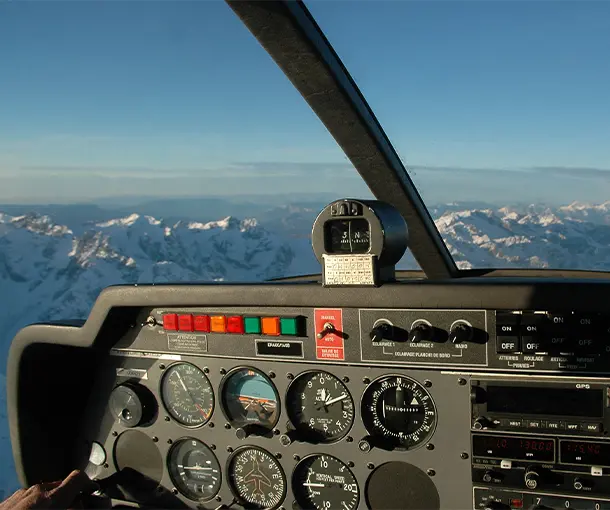

Time building – Consolidation of experience
Structure your experience and demonstrate your operational maturity.
Time building is a strategic stage in the career of a professional pilot. Beyond accumulating flight hours, it involves developing true decision-making autonomy, refining complex navigation skills, and strengthening analytical abilities in real-life situations.
This program is designed for pilots who wish to consolidate their experience as captain, optimize the quality of their flight hours, and structure their progress in a professional manner. Each flight becomes a learning tool: in-depth preparation, performance management, airspace control, risk anticipation, and educational debriefings.
At Hexagone Aviation School, we favor a structured and demanding approach to training. Our goal is not simply to increase your flight log, but to support you in building a solid, consistent profile that will prepare you for the next steps in your aviation career.
-
Real development of autonomy
Decision-making, managing the unexpected, anticipation: you build your operational maturity.
-
Demanding and varied navigation
Complex airspace, controlled terrain, optimized planning.
-
In-depth professional debriefings
Decision analysis, threat and error management (TEM), continuous improvement.
-
Employability-oriented approach
Structuring a coherent flight log and preparing for professional industry standards.
-
Individualized support
Support consistent with your career plans and development goals.
The Time building – Experience Consolidation program aims to structure and enhance your progress as a pilot. It is not just a matter of accumulating flight hours, but of developing true operational maturity, which is essential for any professional development.
Specifically, upon completion of the program, you will be able to:
- Plan and conduct complex navigations completely independently,
- Optimize fuel management, performance, and safety margins.
- Working in varied and demanding environments,
- Make structured and justified decisions in real-life situations.
- Anticipate threats and manage errors using a TEM approach,
- Demonstrate cockpit discipline and professional methodology,
- Structure a consistent flight logbook with a view to moving into the professional sector.
Each flight is used as a teaching tool: thorough preparation, strategic analysis, and structured debriefing enable measurable, qualitative progress.
Our goal is clear: to support you in building a solid, independent, and credible pilot profile for the rest of your aeronautical career.
The time building – Experience Consolidation program is part of a professional development approach. It aims to strengthen the pilot's operational credibility and structure their experience with a view to the next stages of their career.
At the end of the program, you will have:
- Consolidate your experience as a captain,
- Developed decision-making autonomy
- Strengthen your risk analysis and management capabilities,
- Structured a coherent and valuable flight log,
- Improved your operational discipline and methodological rigor,
- Prepare for your transition to advanced training
This program is a strategic step between initial training and entry into a demanding professional environment. It allows flight hours to be transformed into real operational experience.
The Time building – Experience Consolidation program is intended for pilots who hold a PPL(A) license and wish to develop their experience and prepare for higher qualifications.
It concerns in particular:
- Private pilots wishing to increase their experience as pilots in command,
- Candidates considering CPL(A), IR(A) training or a professional career path,
- Pilots wishing to enhance their navigation autonomy and operational skills,
- PPL holders who wish to structure their progress before embarking on advanced training.
This program is a natural step between the private pilot license and professional training. It allows you to transform your experience into solid operational maturity, which is essential for confidently tackling a more demanding course of study.
Access to the Time building – Experience Consolidation program is open to pilots who meet the following conditions:
- Hold a valid PPL(A) license,
- Hold a valid medical certificate,
- Stay up to date with regulatory requirements (valid SEP where applicable),
An interview or evaluation flight may be conducted in order to tailor the program to the pilot's level and objectives.
Before joining the Time building – Experience Consolidation program, an individualized assessment is carried out in order to tailor the content and scope of the program to the pilot's needs.
This positioning may include:
- An educational interview to analyze the aeronautics project,
- A review of the flight log and recent experience,
- An evaluation flight if necessary,
- Identification of priority areas for improvement.
The goal is to build a coherent, progressive program that is aligned with the pilot's ambitions, whether it be preparation for a CPL(A), an IR(A) qualification, or a general improvement in skills.
At Hexagone Aviation School, maturation is not standardized: it is structured around measurable progress and personalized support.
Fly all year round according to your availability
Practical Information
Customized – defined after initial positioning
Individual activity
Bernard Binet
French or English
Self-funding
Payment by hourly rate or customized package
Thomas GENIN
Domestic and international navigation possible
Starting at €139 including tax
Personalized program based on quote
Framework and support
- 01
Contact us to define your goal: consolidating hours, preparing for a CPL, maintaining skills, or personal development.
We will check your licenses, qualifications, and availability.
- 02
After administrative validation (license, medical, valid SEP), you will have access to the booking schedule.
An evaluation flight may be offered if necessary in order to adapt the support provided.
- 03
You organize your flights according to your availability.
Flights are conducted as captain, in compliance with regulatory requirements and school procedures.
- 04
An instructor can accompany you on request to validate a flight, explore certain technical points in greater depth, or conduct a check flight or refresher course.
- 05
Your flight log evolves at your own pace.
We remain available to advise and guide you as you continue your aeronautical journey.
Training Program
Module 010 - Air Law
Module Objective
Understand the legal framework of VFR flight and comprehend the essential rules for safe operation within airspace.
Module Content
• Rules of the Air
• Airspace and Classification
• Air Traffic and ATS Services
• Pilot Responsibilities
• Mandatory Onboard Documents
• Flight Priorities and Collision Avoidance
Targeted Competencies
• Identify airspaces and their associated constraints
• Apply air law rules in real-world scenarios
• Ensure compliant and safe flight operations
Module 021 - Aircraft General Knowledge
Module Objective
Acquire the technical knowledge required to understand the operational principles of a light aircraft.
Module Content
• Airframe and flight controls
• Piston engine, propeller
• Flight instruments
• Systems: fuel, electrical, heating, etc.
• Limitations, mechanical performance
• Failure prevention
Targeted Competencies
• Identify systems and their limitations
• Understand instrument indications
• Detect abnormal aircraft behavior
Module 030 - Performance and Flight Preparation
Module Objective
Master the calculation and planning tools required for VFR flight preparation.
Module Content
• Weight and balance
• Takeoff and landing performance
• Fuel consumption and endurance
• Navigation log
• Fuel selection and safety margins
• Preparation of a complete flight
Targeted Competencies
• Construct an accurate navigation log
• Verify weight/balance compliance
• Anticipate flight safety margins
Module 040 - Human Performance
Module Objective
Understand human limitations to prevent errors and enhance in-flight decision-making.
Module Content
• Pilot physiology
• Stress, fatigue, vigilance
• Visual and sensory illusions
• Human factors and error management
• Decision-making process
Targeted Competencies
• Detect human risk factors
• Make better in-flight decisions
• Manage one's condition and ensure a safe flight
Module 050 - Meteorology
Module Objective
Identify meteorological phenomena influencing VFR flight safety.
Module Content
• Atmosphere and pressure
• Clouds, fronts, precipitation
• Wind, turbulence, icing
• Visibility and ceiling
• METAR, TAF, SIGMET
• Weather risks in light aviation
Targeted Competencies
• Read and interpret METAR/TAF
• Assess flight weather risks
• Make decisions based on actual conditions
Module 060 - Navigation
Module Objective
Learn to orient oneself, plan, and follow a VFR route independently.
Module Content
• Aeronautical charts
• Drift, heading, track, wind calculations
• ICAO chart reading
• Use of the navigation log
• Visual ground references
• Visual navigation techniques
Targeted Competencies
• Construct a complete navigation plan
• Maintain a track considering wind
• Effectively use visual references
Module 070 - Operational Procedures
Module Objective
Discover the best practices and procedures required for safe light aircraft piloting.
Module Content
• Normal and abnormal procedures
• Ground safety and taxiing
• Radio communication in controlled and uncontrolled airspace
• Failure and emergency management
• Cabin preparation and passenger briefing
• Local safety procedures (cross-country flight, uncontrolled airfield, etc.)
Targeted Competencies
• Correctly manage a normal or abnormal procedure
• Apply best safety practices
• React effectively in emergency situations
Module 081 - Principles of Flight – Aeroplanes
Module Objective
Understand the physical laws enabling aircraft flight and anticipate its in-flight behavior.
Module Content
• Lift and drag
• Center of gravity and stability
• Turns, climb, descent
• Stall and influencing factors
• Ground effect, slips, spirals
Targeted Competencies
• Understand aircraft reactions
• Anticipate a stall or loss of control
• Adjust the aircraft according to the flight profile
Module 090 - Communications
Module Objective
Master basic phraseology and essential communications for VFR flight.
Module Content
• Basic radiotelephony
• Standard VFR phrases
• Departure/arrival procedures
• Communications in controlled airspace
• Emergency and distress messages
Targeted Competencies
• Communicate clearly with ATS services
• Use correct phraseology
• Manage an emergency situation via radio
Our ripening offers
10-hour flight block
€1,690 including tax – or €169 per hour
This package includes:
✔ Aircraft rental
✔ Fuel
✔ Insurance
✔ Maintenance costs
✔ All associated costs
(Excluding landing fees and parking on external grounds)
50-hour flight block
€7,450 including tax – or €149 per hour
This package includes:
✔ Aircraft rental
✔ Fuel
✔ Insurance
✔ Maintenance costs
✔ All associated costs
(Excluding landing fees and parking on external grounds)
100-hour flight block
€13,900 including tax – or €139 per hour
This package includes:
✔ Aircraft rental
✔ Fuel
✔ Insurance
✔ Maintenance costs
✔ All associated costs
(Excluding landing fees and parking on external grounds)
A sliding scale pricing based on your hourly commitment
The more hours you book, the lower your unit price.
Key Competencies Developed During Training
- Be able to validate the 9 PPL(A) theoretical subjects, a prerequisite for commencing practical private pilot training.
- Understand and apply VFR air regulations, the rules of the air, and airspace usage.
- Analyze the performance and limitations of a light aircraft (aerodynamics, weight and balance, operational factors).
- Interpret meteorological information to safely prepare a flight and make decisions based on prevailing conditions.
- Understand the operation of aircraft systems: engines, instruments, flight controls, structure.
- Master the fundamentals of VFR navigation: aeronautical charts, navigation log, drift, ground references.
- Utilize clear and correct phraseology for VFR communication with air traffic control services.
- Develop a robust safety culture, essential for recreational aviation.
Methods Utilized
- In-person or virtual classes
- Illustrated educational materials
- Practical work and in-class exercises
- Mock Exams
- Corrected Feedback
- Dedicated Instructor
- Practice multiple-choice questions (MCQs)
Educational Tools and Resources
- eLearning Platform
- MCQ Database
- Scenario Study, Practical Simulation
- Corrected Mock Exam
-
Supervision available
Fly independently while benefiting from the support of our experienced instructors, if necessary.
-
Flexibility and availability
Access to the schedule all year round. Organize your flights according to your goals and availability.
-
Work environment
Develop your skills in a structured environment, within a dynamic school with close ties to the aviation industry.
-
Clear objective, controlled trajectory
You will develop your experience in line with your aeronautical project and your future qualifications.

Assessment & Certification
Assessment Methods and Procedures
Learning outcomes are continuously assessed throughout the training via online mock exams, thematic MCQs per module, and individualized pedagogical reviews. These evaluations are organized according to the current EASA standards.

Means of Assessing Program Outcomes
Each student benefits from individualized pedagogical support, comprising:
- subject-specific score monitoring,
- progress indicators,
- alerts for targeted pedagogical support when required.
Intermediate assessments are offered to ensure consistent skill development.

Examination Procedures by the Certifying Body
Official PPL(A) examinations are conducted at DGAC examination centers in France, according to the schedule defined by the authority. Hexagone Aviation School assists students with:
- appointment scheduling,
- the compilation of examination application files,
- logistical and psychological preparation for the examination.

Training Certification and Course Completion Certificate
Upon completion of the PPL(A) training, each student receives a personalized certificate of completion, issued by Hexagone Aviation School. This document specifies the nature and duration of the training undertaken, and confirms that all mandatory modules have been completed in accordance with the requirements of the EASA-defined PPL theoretical syllabus. This certificate serves as an official validation of the training and attests that the candidate is now eligible to sit for the PPL(A) theoretical examinations organized by the DGAC. It represents a crucial step in the journey towards obtaining a pilot license.
EASA-recognized and compliant training
The PPL(A) theoretical course is not registered with the RNCP, as it falls directly under European Part-FCL / EASA regulations.
However, its content is fully compliant with European standards and meets all official requirements for obtaining the Private Pilot License (Aeroplane).
It constitutes the essential regulatory foundation for progressing towards all light aviation or modular licenses and ratings.
Career Prospects
The PPL(A) allows you to fly an aircraft under VFR, carry passengers, and enjoy light aviation for leisure, travel, and exploration.
It provides access to numerous aeronautical activities:
• Local flights and VFR navigation
• Travel and recreational flights
• Flights within flying clubs
• Skill enhancement, safety, continuous progression
It also opens the doors to a professional career path.
Further Training Progression
Upon completion of the PPL(A) theoretical training, students naturally progress to practical training, an essential step to obtain their Private Pilot License and complete their first solo flights. Once the license is acquired, several avenues for progression become available: the Night Rating for night flying, the FCL.055 to master aviation English, or additional ratings such as the IR(A), the MEP, or even the ATPL(A) theoretical for those aiming for a modular professional pathway. At Hexagone Aviation School, we support you in these choices through personalized guidance, to build a coherent aeronautical trajectory, whether it is dedicated to leisure or oriented towards a future career.
Martin
We had a great experience working with the Hexagone Aviation team, who were very responsive in making our training as enjoyable as possible!
Alexandra
An excellent school for obtaining your ATPL. Competent instructors, high-quality equipment, and a very pleasant atmosphere. I highly recommend it!

Thibaut
I chose Hexagone Aviation School for the flexibility of its eLearning, but I did not anticipate such a high level of support. The pedagogical team is available, supportive, and highly professional.

Access your flight in just a few steps
Initial Contact
Needs Assessment
Prerequisite Validation
Takeoff!
Contractual Information and Guarantees
You Have the Right to Change Your Mind
A statutory 14-day cooling-off period applies following the signing of the contract or training agreement, in accordance with Article L221-18 of the French Consumer Code.
In Case of Inability to Undertake Training
Should the training program be unable to be commenced or completed due to circumstances beyond your control (e.g., force majeure or incapacity), options for postponement, partial refund, or adjustment will be offered, in accordance with our pedagogical and administrative terms.
A Solution for Training Interruption
Any voluntary or involuntary interruption will result in a personalized review of your situation. Depending on the timing of the cessation, a partial refund, credit, or deferred resumption solution may be considered, in adherence to mutual commitments.
We Handle Every Dispute with Equity
In the event of a dispute, an amicable mediation process is preferred. If necessary, an appeal may be lodged with the consumer mediator or the competent courts. Our priority: dialogue, transparency, and the pursuit of solutions.
A Clear Reciprocal Commitment
Enrollment in the training program entails active commitment from the student: attendance, participation, and adherence to the pedagogical framework. For our part, we commit to providing the human, technical, and organizational resources necessary for the complete execution of the training.
A Secure Contractual Framework for Each Student
Each student, depending on their profile, signs either a training agreement or a professional training contract. This document specifies the pedagogical terms, the rights and obligations of each party, the financial conditions, and the execution modalities. It is supplemented by our General Terms and Conditions of Sale, available upon request.